Back to the blog
Alloggiati Web at a 200-pitch campground: how to do it without blocking reception
2026-08-19
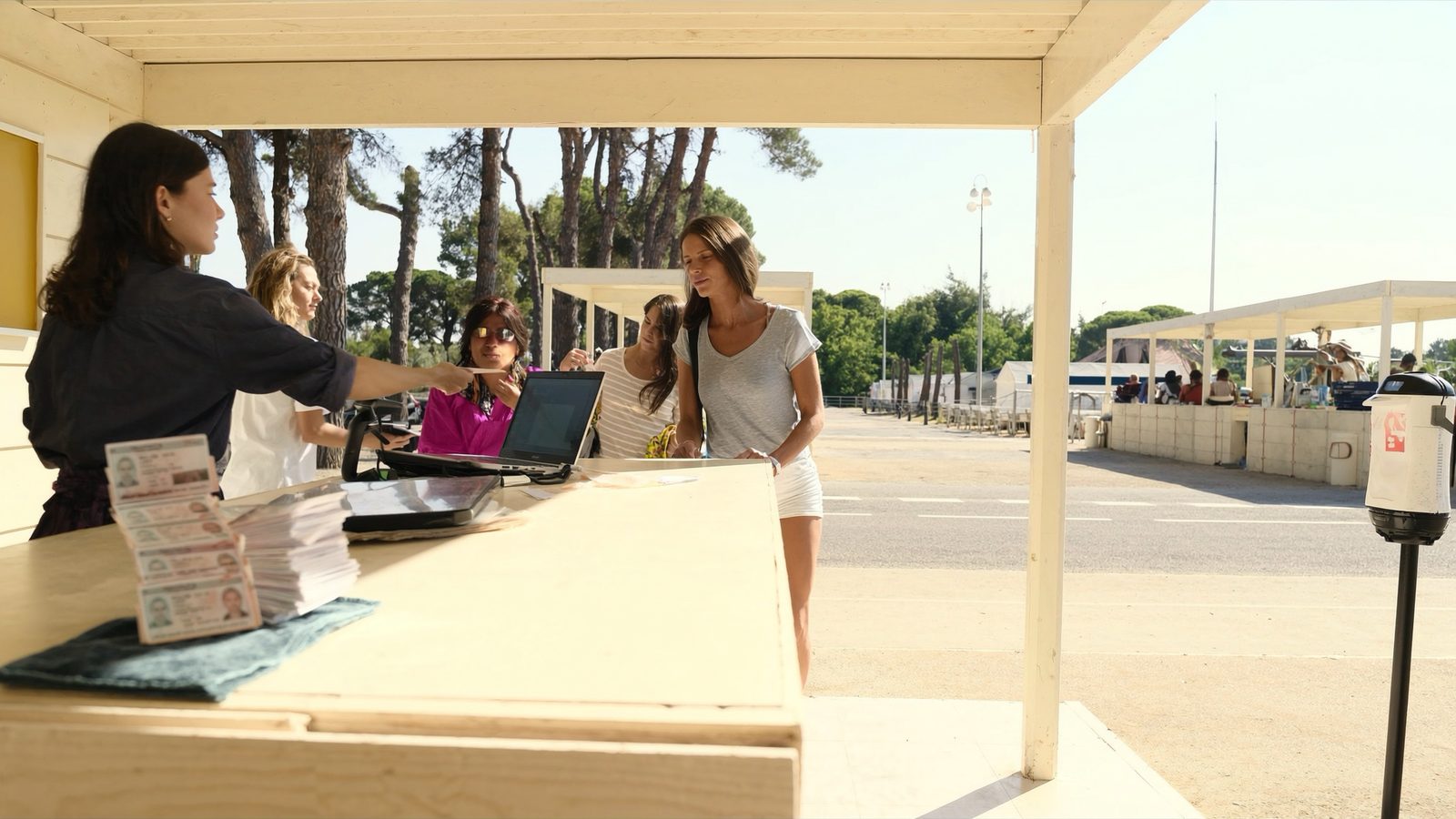
There is a difference worth putting on the table straight away. Whoever runs a motorhome stopover spends months wondering whether the obligation applies to them, because how those sites are classified has been argued over for years. Whoever runs a campground has no such doubt: a campground is an open-air accommodation business, art. 109 of the TULPS (the Italian consolidated public security act) applies, full stop.
The campground's problem is a different one, and it is about scale. Not "do I have to?", but "how do I do it for eighty arrivals concentrated in four hours of a Saturday afternoon, without the queue leaving reception and reaching the car park".
This article is about that.
The number to keep in your head: not bookings, people
The first thing that breaks at a campground is the confusion between bookings and guests to report.
A high-season Saturday with 80 arrivals is not a Saturday with 80 filings. A tent pitch with a family of four is four guests. A six-berth mobile home occupied by a group of friends is six. A scout group across three pitches is twenty-four people.
Eighty arrivals at an average campground means between 220 and 280 people to report in one afternoon. If your process is "I fill in the form at the desk while the customer waits", the bottleneck is not the police portal: it is you.
The 24 hours start from arrival, not from the desk
This is the point that produces the most unintentional breaches at campgrounds, and it comes from something good: out-of-hours arrivals.
The deadline in art. 109 runs from the guest's arrival at the site. If you have set up evening access — a code, a barrier, an automatic gate — and a family comes in at 10:40 pm on Saturday to go to sleep, their 24 hours have already begun. If that family drops by reception on Sunday at 10 to "sort out the paperwork" and you file on Monday morning along with everything else, you are out of time on a filing you thought was in order.
Anyone with no evening arrivals does not have this problem, because arrival and check-in coincide. Anyone who does — and at a campground almost everyone does, at least for latecomers — has to keep the two apart: data collection has to happen before or during entry, not after.
For short stays the window is tighter still: if the stay does not exceed 24 hours, the report has to be filed within 6 hours of arrival. The one-night stopover, which at campgrounds on through routes very much exists, has to be handled the same day.
Where the minutes go, measured
Try timing a real check-in at your campground. Done properly, with the paper form, it comes out in these orders of magnitude:
| Step | Typical time |
|---|---|
| Greeting, finding the booking, confirming the pitch | 60–90 s |
| Asking for and collecting the party's documents | 90–150 s |
| Copying the details onto the form by hand | 120–240 s |
| Explaining the rules, opening hours, map, keys | 90–120 s |
| Payment and receipt | 60–120 s |
That is 7–12 minutes per party. With one person at the desk and 80 arrivals, that is between nine and sixteen hours of work compressed into a window that lasts four. No amount of organisation fixes it: either you put three people at the desk, or you move the work outside the window.
Copying by hand — those 2 to 4 minutes — is the line item that can be reduced to zero, and it is also the one that produces the errors the portal later rejects.
Move the collection before the arrival
The only solution that survives the August test is collecting the data before the guest reaches the gate.
In practice: on booking confirmation the guest receives a link, enters the members of the party and uploads their documents from their phone, at their leisure, from their sofa at home. By the time they reach the desk their form already exists: what is left at the desk is the greeting, the keys and the map.
The objections I hear most often, with the answers:
"My customers are elderly, they won't do it." Some won't, and that is normal. But if 60% of parties do it, Saturday goes from 280 people to transcribe to 110. It does not have to work for everyone: it has to work for the majority.
"I still have to check the document in person." Visually checking a document that is already recorded takes about ten seconds. Transcribing it from scratch takes two hundred. They are two different activities, and pre-check-in removes the second, not the first.
"I don't trust the data they enter." Fair, and indeed the responsibility for the filing stays yours. But a piece of data typed by the guest that you then verify is more reliable than one you copy by hand from a document read in a hurry with ten people queuing.
Head of family and Group leader: the feature nobody uses
Alloggiati Web provides different guest types, and at a campground they make an enormous difference.
- Single guest — someone travelling alone.
- Head of family + Family member — the family party.
- Group leader + Group member — the organised group.
For the head of family and the group leader you need the full document details. For family members and group members, personal details are enough.
On a scout group of twenty-four people that means one document instead of twenty-four. On a family of five, one instead of five. It is the feature I most often find unused at campgrounds, and on its own it is worth half the desk time on a Saturday full of groups.
The campground calendar against the compliance calendar
A campground has a shape of season no other accommodation business has, and it produces two recurring traps.
The first: the closure. From November to March you have no arrivals and you forget about the portal. Then you reopen in April and the credentials no longer work, or the account has to be renewed, or something has changed in the file format. That is not a problem on 15 April with four arrivals; it is a problem on 1 May with seventy. The first login of the year should happen two weeks before opening, not on opening day.
The second: seasonal guests. Someone keeping a pitch from April to October is reported on arrival, with the expected number of days. But a seasonal guest is not one person sitting still for six months: it is a household that comes and goes, with relatives passing the weekend and friends staying a night. Anyone spending the night has to be reported, even if the pitch is already in somebody else's name. It is the most crowded grey area in Italian campgrounds, and in an inspection it is not a defensible grey.
What to do when the portal is down
It happens, and it happens on the worst days. The practical rule is simple: the outage does not make you compliant, diligence does.
Concretely:
- Collect the data on time anyway, with the collection time recorded.
- Retry at intervals, not the next day.
- Keep the receipt as soon as the filing goes through.
- If the outage lasts, document the attempt — a screenshot with date and time costs nothing.
What protects you in an inspection is the chain: data collected on time, attempts documented, filing made as soon as possible.
The receipts: the part that saves you
The portal issues a receipt for every filing. It is the only proof that the filing happened, and on what date.
At a campground with a hundred and eighty filings a season, "they are all somewhere in my inbox" is not an archive. An inspection asking for the receipts of three specific dates in August has to be satisfied in five minutes, not in an evening of searching.
The criterion is banal but has to be decided once: the receipts live in one place, ordered by date, and you get to them in two clicks. Whether it is a folder on the server, a ring binder or the software keeping them with the booking, what matters is that the place is one.
What you actually risk
Failing to report is not an administrative penalty: art. 17 of the TULPS frames it as up to three months' detention or a fine of up to €206. The figure is modest, its criminal nature is not, and in repeat cases the heavy consequence is not the fine but the measure taken against the business.
Then there is the part nobody budgets for: an inspection in August, with reception full, that keeps you tied up for an hour. That is the real cost.
In practice: the checklist before opening
- Portal credentials verified at least two weeks before opening.
- Pre-check-in active on every booking confirmation, not just direct ones.
- Head of family and Group leader types configured and explained to whoever is at the desk.
- A written procedure — one page — for arrivals after reception closes.
- Receipt archive in one place, searchable by date.
- A clear rule on seasonal guests' visitors: whoever sleeps here gets reported.
The time a campground loses on Alloggiati Web is not lost in the legislation: it is lost in transcription. The text of the law takes ten minutes to read; changeover Saturday lasts all season.
On CampinGate the data is collected at booking time and the filing goes out on its own, with the receipt kept alongside the stay. See how it works or write to us and we will talk it through with your August calendar in front of us.