Back to the blog
The obligations a campground has and a hotel does not: fire safety, swimming pool, CIN and multiple tills
2026-08-17
Search for "accommodation business obligations 2026" and you find dozens of articles. They are all written with a hotel in mind: check-in, CIN, receipts, tourist tax, privacy. Real things, and they apply to you too.
But a campground is not a hotel with grass. It is an accommodation business plus a small piece of infrastructure: electrical systems spread over hectares, a swimming pool, often a bar, a shop, sanitary blocks, and accommodation that counts as dwelling units to all intents and purposes. Each of these brings obligations the hotel does not have.
This article skips the common part and goes straight to the part that concerns only you.
1. Fire prevention: the 400-person threshold
It is the first obligation that clearly separates a campground from other accommodation businesses, and it has to be known by the number.
Open-air tourist accommodation with a capacity of more than 400 people falls under activity 66 of annex I to presidential decree 151/2011. That means a fire prevention procedure: a notification to the provincial Fire Brigade command, a project where required, periodic renewal of the certification.
The reference technical code is the one approved by the ministerial decree of 28 February 2014, written specifically for open-air sites: distances between pitches, width of access lanes, accessibility for emergency vehicles, systems, mobile accommodation, tent areas.
The number that catches you out
The threshold is in people, not in pitches. And the count adds the capacity of the pitches to that of the accommodation units.
A campground with 120 pitches and 25 six-berth mobile homes is not "a 120-pitch campground": it is a site that, once counted according to the criteria of the technical code, is very probably above 400 places. Many operators discover they are subject to the procedure after adding a dozen units of fixed accommodation, and nobody told them at the time of purchase.
If you are considering expanding your mobile home offering, the sum has to be redone before you order them, not after.
Below 400 you are not exempt
Not being subject to the procedure does not mean having no obligations. The employer's general safety obligations remain, along with the fire risk assessment, the extinguishers, staff training and the emergency plan. What changes is that you do not have the Fire Brigade command as a formal counterpart.
2. The pool: an activity inside the activity
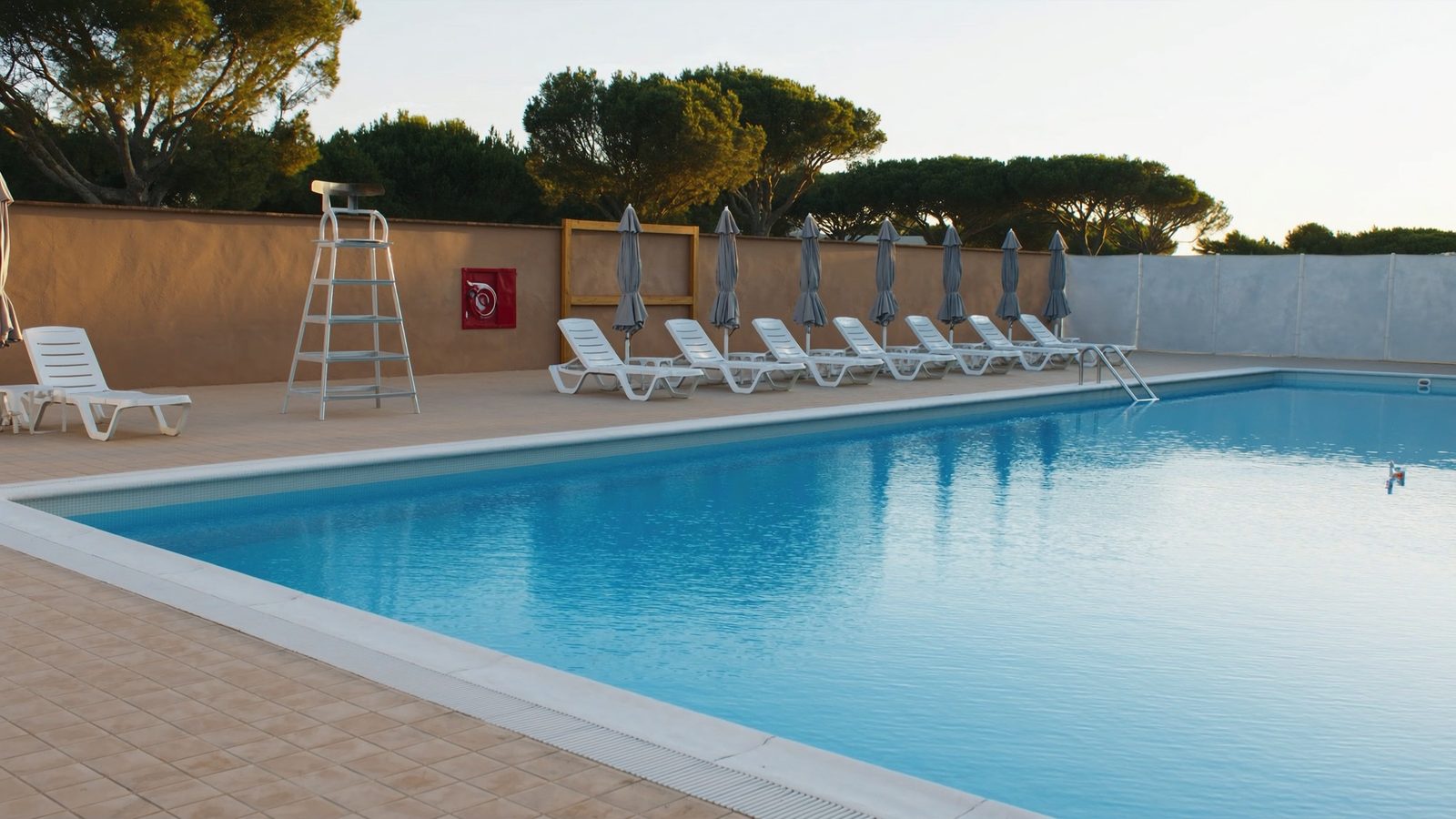
If you have a swimming pool, you have a second block of obligations that lives its own life, with mandatory roles and daily registers.
The reference is the State-Regions agreement of 16 January 2003, implemented through regional laws and regulations that change the details but not the structure. Pools attached to accommodation businesses are pools for collective use: they are not private, and good intentions are not enough.
What it involves, concretely:
- Pool manager — the person answerable for overall management.
- Plant operator — with specific training, for filtration, disinfection and water treatment.
- Lifeguard — qualified, present during opening hours, in the ratios your regional rules require.
- Control register — chlorine, pH, temperature, turbidity, measured and recorded at the required frequency, every day you are open.
- Periodic laboratory analyses — at the frequency set by your region.
- Rules and signage — displayed, legible, up to date.
The thing that gets underestimated is the register. It is not a formality: in an inspection or after an accident it is the document everything hinges on. A register filled in at the end of the day "from memory" is not a register.
3. Bar, shop, restaurant: the food chain
If you serve or sell food — even just the shop with bread in the morning — you enter food safety regulation: health notification, HACCP self-monitoring manual, staff training, traceability.
It is not a "campground" obligation in the strict sense, but it is the second activity almost every campground has and almost no hotel of comparable size runs as casually. The seasonal shop open for three months has the same obligations as the shop open all year.
4. CIN and the national database: the problem of units
The national identification code and the accommodation database apply to campgrounds too. The part that produces errors is how units are declared.
A hotel has rooms. A campground has pitches of different types, plus possibly bungalows, mobile homes, glamping units, cabins. How these map onto the database's structure depends on the regional classification of your site: campground, holiday village, campground-village, and the local variants.
The practical rule: check the classification before filling anything in, not after. Correcting a wrong registration takes longer than getting it right, and in the meantime the code you display and quote in your listings is the wrong one.
Once obtained, the CIN has to be displayed and quoted in listings. For a campground "listings" are not just your website: they are also the entries on sector portals, camping club directories, catalogues. It is an alignment job worth doing once and properly, at the start of the season.
5. Receipts in 2026: the problem is not the till, it is the tills
From 2026 the electronic payment device has to be connected to the electronic till, so that the electronic takings and the receipts transmitted to the tax authority match.
At a site with a single till that is something you sort out in a morning. At a campground there are three or four tills: reception, bar, shop, sometimes rentals or the laundry. Each has its own card reader and its own till, and each has to be sorted out separately.
The three things I most often see going wrong:
The reception card reader also used for the bar in the evening. If the money goes through one device and the receipt comes out of another till, the connection is not there. It is a very convenient shortcut that produces a discrepancy at the end of the season which is hard to explain.
The shop till switched off since October. A device inactive for months has to be reactivated and checked before reopening, not on the first day with a queue at the till.
Advance payments. A deposit taken in March for a stay in August has to be treated for what it is. The moment you issue the commercial document and the moment the customer stays do not coincide, and it is something to agree with your own adviser before the season, not in hindsight.
6. Systems: the part you only see when it breaks
A campground distributes electricity over hectares, often with a pillar on every pitch, in an outdoor environment exposed to water, earth and knocks.
- Declarations of conformity for the systems and periodic checks of the earthing system.
- Pitch supply pillars: residual current devices, protections, an ingress protection rating suitable for outdoor use.
- Path lighting and emergency lighting where required.
- Water system and potability: checks on water intended for human consumption, and — if you have tanks, storage or outdoor showers — the legionella risk assessment, which in accommodation businesses is not an item to leave on the table.
None of these is new for 2026. They are the items that, having no deadline that reaches you by email, slip from one year to the next until an inspection or a breakdown arrives in August.
7. Regional classification
Campground stars are a regional matter, and the classification determines minimum requirements: pitch area, ratio of toilets to places, mandatory facilities, services to be guaranteed.
Two things to keep an eye on:
- If you change the site, the classification may have to be updated. Adding fixed accommodation, changing the ratio between pitches and accommodation units, closing a sanitary block: all things that touch the requirements.
- The classification has to be renewed or confirmed according to your region's rules. It is not a title acquired once and for all.
The start-of-season checklist, in an hour
Before opening, not after:
- Receptive capacity recalculated in people — are you above or below 400? If you have added accommodation, redo the sum.
- Fire safety file up to date and certification currently valid.
- Pool: mandatory roles appointed, register ready, first analysis scheduled.
- Food: notification in order, HACCP manual updated, seasonal staff trained before they start work.
- CIN displayed and aligned on your site, portals and catalogues.
- Every point of sale with its card reader connected to the electronic till, tills reactivated and checked.
- Systems: earthing check, supply pillars, emergency lighting, water tests.
- Credentials for Alloggiati Web and the regional statistical platform tested.
- Regional classification consistent with the site as it is today.
This article does not replace your adviser, your fire safety engineer and your regional office: it exists so that you know which questions to ask, because almost everything you find online about accommodation compliance ignores the existence of businesses with grass, a pool and three tills.
On the management side — guest-nights, tourist tax, police and statistical filings — CampinGate derives them from data entered once. See how.