Back to the blog
The reception queue on peak Saturday: where it comes from, and the arithmetic that dismantles it
2026-08-07
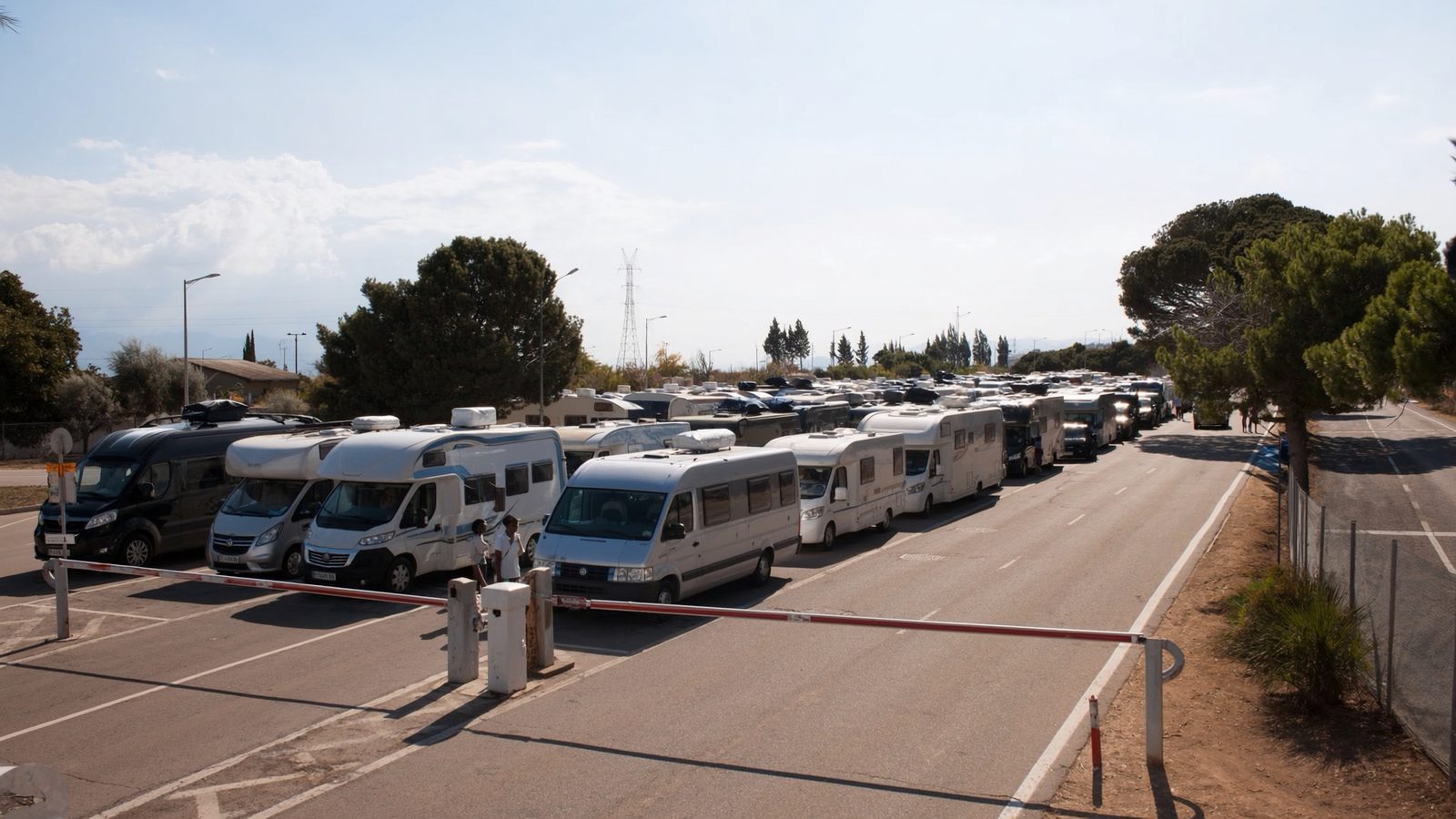
There is a moment, at every campground, when everything you have built is judged: changeover Saturday in high season, between two and six in the afternoon.
It is the moment when a new customer forms their opinion of your campground. It is also the moment when, at a great many sites, that customer is standing in the sun with two crying children and a loaded car.
The queue is not the fault of whoever is at the desk. It is arithmetic, and like all arithmetic it can be solved.
The sum nobody does
Take a normal Saturday in August:
- 80 parties arriving
- concentrated between 2 pm and 6 pm — four hours
- 8 minutes average time to serve one party at the desk
- 2 desks open
Two numbers:
Arrivals   = 80 parties ÷ 4 hours          = 20 parties/hour
Capacity   = 2 desks × (60 ÷ 8 min)        = 15 parties/hour
Twenty parties arrive per hour, you serve fifteen.
The difference is not absorbed: it accumulates. Five parties an hour left behind, for four hours.
| Time | Arrived | Served | Queueing |
|---|---|---|---|
| 3 pm | 20 | 15 | 5 |
| 4 pm | 40 | 30 | 10 |
| 5 pm | 60 | 45 | 15 |
| 6 pm | 80 | 60 | 20 |
At 6 pm the arrivals stop and twenty parties are still waiting. It will take another hour and twenty minutes to clear them: you finish at 7:20 pm, with the bar already full and nobody at the desk for the rest of the evening.
The last arrival waited eighty minutes. Not because anyone was slow: because the system could not do otherwise.
This is the important thing to grasp, and it changes how you tackle the problem. When arrivals exceed capacity, the queue does not settle at an average wait: it grows linearly for as long as the arrivals last. "Going a bit faster" will not do it. You have to change one of the numbers.
There are only three numbers to change
The formula shows there are three levers, and there is no fourth.
Lever 1 — The service time
Break the eight minutes down:
| Step | Minutes |
|---|---|
| Finding the booking, confirming, assigning the pitch | 1.5 |
| Documents: asking, collecting, transcribing | 3.0 |
| Site rules, opening hours, map, explanations | 2.0 |
| Taking the balance and issuing the receipt | 1.5 |
The three minutes of documents are the only block that can be taken to zero, by moving it before the arrival: if the guest has already entered the members of the party and uploaded the documents from their phone, what is left at the desk is a twenty-second visual check.
The balance is the second removable block: if it has already been taken online, a minute and a half and the queue at the till both disappear.
Eight minutes become four:
Capacity = 2 × (60 ÷ 4) = 30 parties/hour
Thirty against twenty arrivals. The structural queue disappears. What remains is the normal fluctuation — three parties turning up together — which clears in a few minutes.
Note the disproportion: you halved the service time and the queue did not halve, it vanished. That is the typical behaviour of these systems: as soon as capacity exceeds arrivals, the wait collapses. It is also why small improvements seem to achieve nothing until you cross the threshold, and then suddenly they fix everything.
Lever 2 — The desks
Adding a third desk takes capacity from 15 to 22.5 parties/hour. Above the twenty arrivals: this works too.
But it costs an extra person for the whole high season, and it is only needed for four hours on Saturday. It is the most expensive lever and the least elegant, and it is the one almost every campground uses because it is the only one you can decide on Friday evening.
Lever 3 — Spread the arrivals out
Eighty parties over six hours instead of four:
Arrivals = 80 ÷ 6 = 13.3 parties/hour
Below the fifteen of your current capacity. It works without touching anything else.
How you do it, without imposing timetables on people on holiday:
- Ask for an arrival window at booking. Simply asking already shifts a share of parties, because many have no strong preference and pick the window you suggest.
- Make arriving late desirable. Someone who has already paid and has their entry code can arrive at 8 pm and go straight to the pitch without passing the desk. For a family driving five hundred kilometres, "come whenever you like, you can still get in" is a real benefit.
- Make arriving early desirable. If the pitch is free from midday, telling long-stay bookers moves the first parties out of the peak.
- Separate seasonal guests and returners. Someone who knows the campground does not need the two-minute explanation. A fast lane, even just a table, takes the parties who are served in ninety seconds out of the main flow.
The invisible queue: departures that have not left
There is a second queue that does not show in the statistics and that ruins the afternoon even when the desk is running well.
The guest checked in in three minutes, is happy, walks to pitch 112 — and pitch 112 still has the caravan of the people who were due to leave at 10 and are packing up at their leisure. Or it is free but has not been cleaned yet.
That party is not queuing. It is wandering the campground, and comes back to the desk every twenty minutes to ask. Every return is an interruption that lengthens service for the people actually queuing, and every interruption generates more.
Three things that reduce it:
- The departure time has to be communicated as a commitment, not as a suggestion, and reminded the evening before. An automatic message on Friday evening costs nothing.
- The departure round has to happen at a set time, not "whenever": at 10:30 somebody walks round and checks which pitches are actually free, and that goes into the system.
- Freed pitches have to be visible from the desk in real time. If whoever is checking people in has to radio through to find out whether 112 is ready, you have added two minutes to everyone's service time.
What an hour of queueing really costs
The cost you see is the staff. The one you do not see weighs more.
The first evening's bar. A party that arrives at 3 and settles in by 4 has an aperitif. A party that settles in at 7:30 pitches the tent in the dark, opens a tin and goes to bed. Across eighty parties that is dozens of sales that never happen, every Saturday.
The reviews. The check-in queue is, along with the state of the toilet block, one of the two things that appear most often in negative campground reviews. And it is the one a potential customer reads as a signal of general disorganisation.
The start of the stay. A guest who begins their holiday after an hour and a half standing in the sun judges everything else that week more harshly: the lukewarm shower, the noisy neighbour, the price of ice. It is a real effect and it cannot be recovered.
The sum for your campground, in ten minutes
Take the busiest Saturday of last season:
- How many parties arrived? (parties, not people)
- Over how many hours were they concentrated? → arrivals/hour
- How many minutes does a check-in take at your place? Time five real ones, do not estimate.
- How many desks were open? → capacity/hour
If the first number is bigger than the second, next August's queue is already written. And you also know how far you have to move the levers: capacity only has to exceed arrivals, not crush them.
On CampinGate documents and the balance are collected before arrival, freed pitches are visible in real time and whoever arrives out of hours gets in with their own code. The desk stays, it just stops being the bottleneck. See how it works.